Company
Jun 24, 2026
We've raised $12.5M to build state-of-the-art Web Search for agents

Antonio Mallia
Our $12.5M seed, and why web search built for people clicking links is the wrong system for agents.

Today we're announcing our $12.5 million seed round to rebuild web search for agents.
The last time search was reinvented, the consumer was a person typing a few words into a box. Today, agents ask a growing share of the internet's questions, and they have little in common with the people before them.
They write paragraph-long queries and run hundreds in parallel. They never misspell, and never refine a search the way we do.
I've spent over a decade on web search, as a researcher and building it at Amazon. Seltz is the product of watching this evolution. The web search infrastructure of twenty years ago won't exist in 2028.
Web search for agents isn't web search for humans with a different output format. It's a different system, built from scratch.
Owning every layer of a search stack at open-web scale is one of the most capital-intensive problems in software, and most competitors avoid it. We raised to take it on properly: to scale to 10s of billions of documents and build the team to get it in front of the companies that need it.
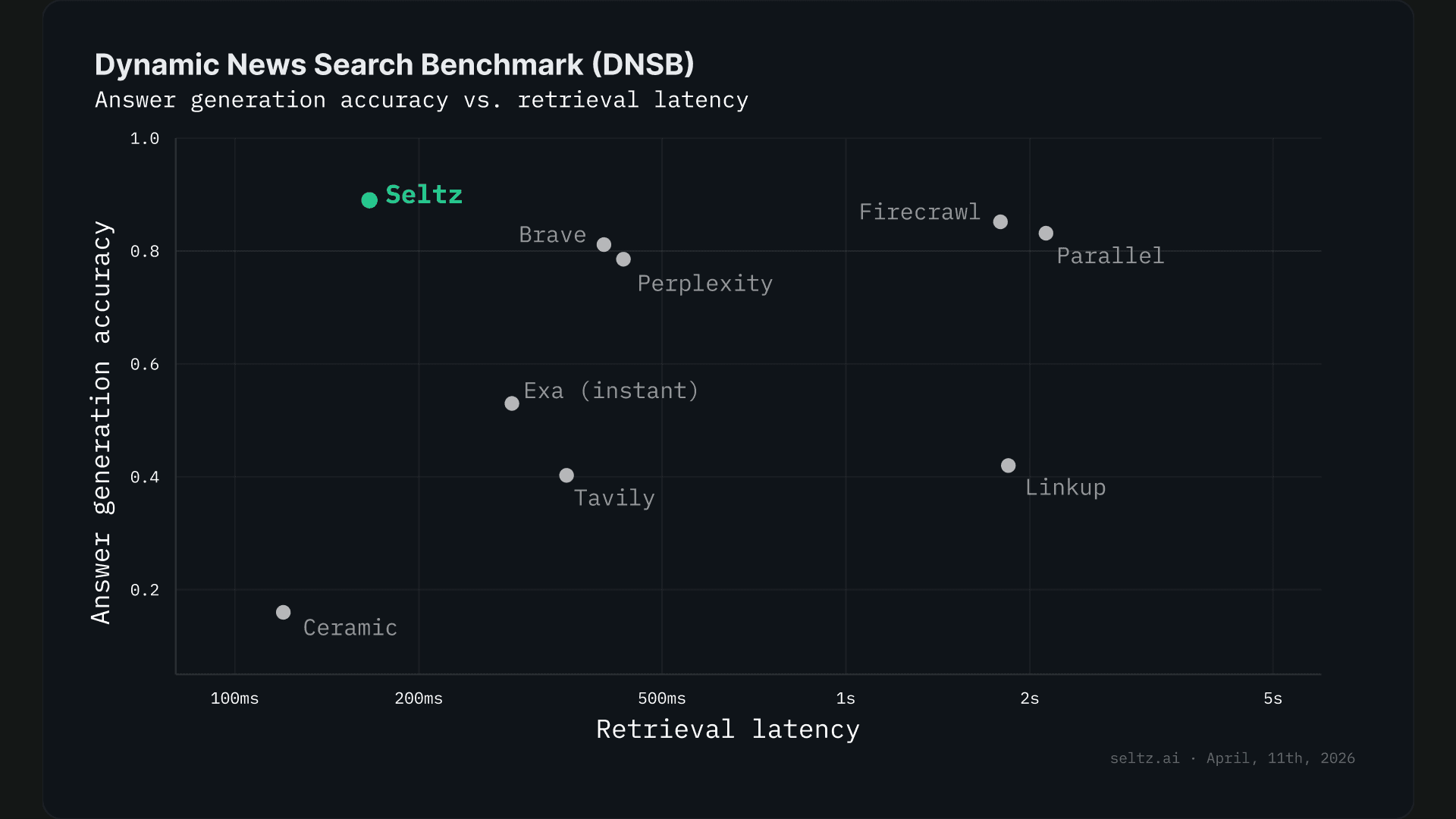
In eight months, we shipped a news index that leads every provider. On our Dynamic News Search Benchmark, Seltz answers at 89% accuracy, 5% higher than the next-best, and returns them in under 250 milliseconds, 7 to 30 times faster than others we tested.
What "built from scratch" actually means
Answer quality and latency are usually a trade-off. Owning the stack end-to-end lets us be fantastic at both, with design decisions others can't.
Some examples:
We return the full document, not a preview. Agents don't spend turns getting to what they need, making the whole search more token-efficient and faster.
We own our index, so our documents differ from Google's. Wrap an existing engine and you return the same documents, paying for overlap and latency without new information. Ours don't, so an agent pulling from several sources gets a different set and broader coverage, not redundancy.
We go deep where general indexes are thin. We build separate indexes for specific categories, tuning each vertical to its information's shape instead of a general-purpose index.
We run inside your own infrastructure. We deploy on-premises, in private cloud, or in whatever region your data rules require, and we're SOC 2 Type II compliant, so an agent reaches the live web without its queries ever leaving your control.
Our team, and what comes next
I'm most proud of our team. We're fifteen, across the US and Europe. Most hold PhDs or did postdoc work in information retrieval, and several came from Amazon's search teams, where I was a research scientist.
We're early and honest about it: we started commercial work late last year, have a foundational lab under contract, and are running pilots with teams building agentic workflows.
The round was led by B Capital and Speedinvest, with participation from Future Present, Italian Founders Fund, Arc Investors, United Ventures, Vento Ventures, Mango Capital, 2100 Ventures, and Future Back Ventures,alongside angels from Google, Ramp, Tako, and Hugging Face.
We're investing in two fronts:
Engineering: getting from a handful of verticals to the open web, with on-premises and in-region deployment built in, is multi-year work.
Sales and marketing: we've been heads-down on the technology, and the product is well ahead of the people who know it exists, so much of this round funds a commercial team to put Seltz in front of the engineers and enterprises it was built for.
In the near future, agents may do for the next search engine what human clicks did for the last. They explore the web, judge what they find, and help assemble the index other agents query: an index built for agents, in part by agents. That's what we're building Seltz to become.
If you're building agents that need the live web as context, chat with us.